How to Calculate Split Shift Hours: The Complete Guide
Key Takeaways
- A Split Shift is two work periods separated by an unpaid break longer than 60 minutes.
- The Formula: (End Time A - Start Time A) + (End Time B - Start Time B) = Total Hours.
- California Rule: Employees may be owed 1 extra hour of pay ("Split Shift Premium") if they earn near minimum wage.
- New York Rule: "Spread of Hours" pay applies if the workday spans more than 10 hours.
Table of Contents
In the hospitality and healthcare industries, the 9-to-5 workday is rare. Instead, managers often rely on split shifts—where an employee works two distinct blocks of time in a single day, separated by a long break.
What is a Split Shift?
A split shift occurs when an employee's daily work schedule is interrupted by a non-paid, non-working period established by the employer. Crucially, this break must be longer than a bona fide meal period (typically longer than 60 minutes).
Example Scenario
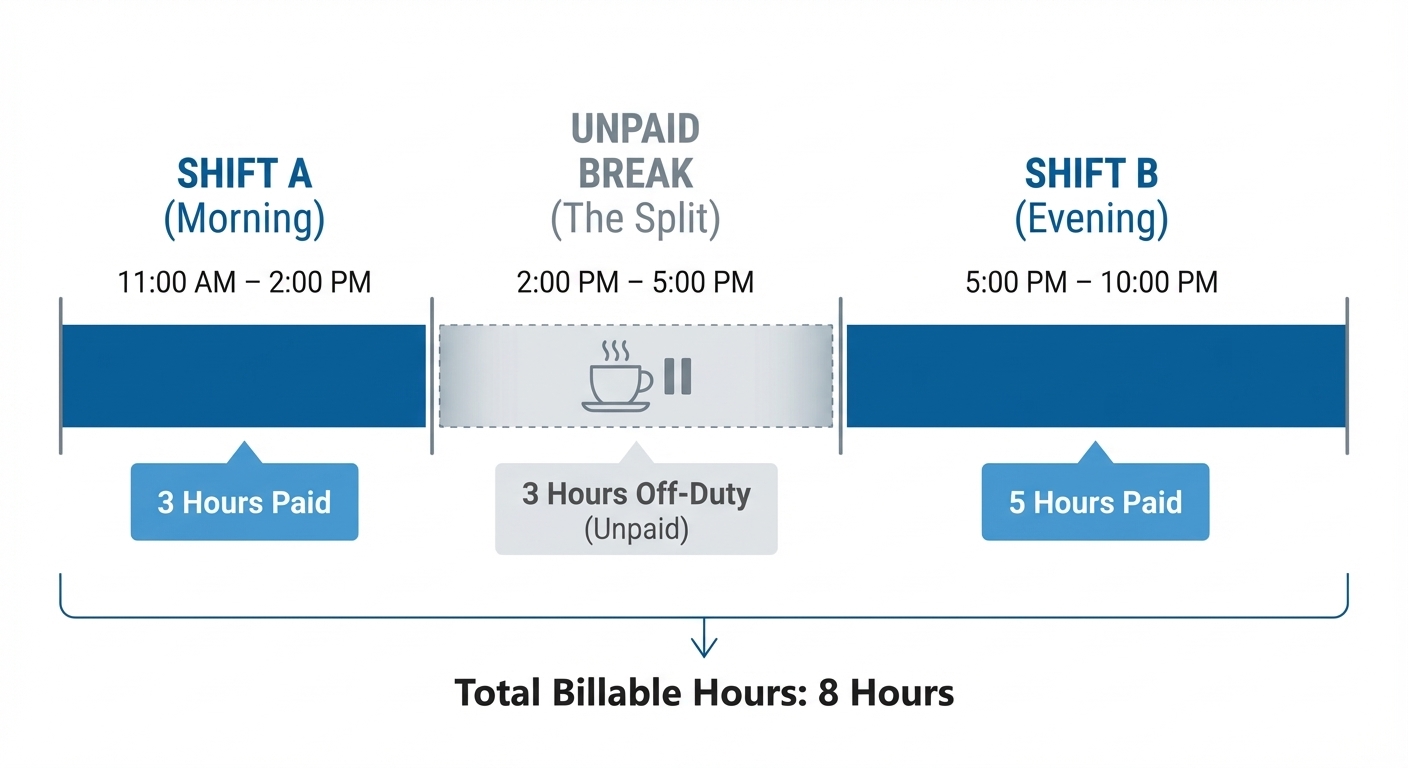
- Shift A (Lunch): 11:00 AM to 2:00 PM (3 Hours)
- Unpaid Break: 2:00 PM to 5:00 PM (3 Hours Off)
- Shift B (Dinner): 5:00 PM to 10:00 PM (5 Hours)
The Calculation Formula
To calculate the total pay for a split shift, you simply sum the duration of the two working blocks. You do not pay for the gap in the middle.
- Block 1: 3 Hours
- Block 2: 5 Hours
- Total: 8 Billable Hours
California Split Shift Premium
If you are in California (IWC Wage Orders), simply paying for the hours worked might be illegal. You may owe a Split Shift Premium.
This premium is one hour of pay at the minimum wage rate. It is designed to compensate the employee for the inconvenience of having their day broken up.
New York "Spread of Hours"
New York has a similar law called "Spread of Hours." This measures the time from the very start of the day (11:00 AM) to the very end (10:00 PM). In our example, the "Spread" is 11 hours.
Under NY Labor Law, if the spread exceeds 10 hours, the employee is entitled to one extra hour of pay at the minimum wage rate.
Frequently Asked Questions
1. Do I get paid for the break between split shifts?
Generally, no. The time between shifts is considered 'off-duty' time where the employee is free to leave the premises. Therefore, it is unpaid.
2. Does a split shift count towards overtime?
Yes. The total hours worked in both shifts count towards your daily and weekly overtime limits. For example, two 5-hour shifts equal 10 hours worked, which may trigger daily overtime in some states.
3. What qualifies as a split shift?
A split shift is a work schedule interrupted by a non-paid, non-working period established by the employer, which is longer than a typical meal break (usually longer than 60 minutes).
4. Can my employer force me to work a split shift?
In most at-will employment states, yes. Employers can set schedules as needed. However, they must comply with all pay premiums and rest period laws.
5. Is a double shift the same as a split shift?
No. A double shift usually refers to working two consecutive shifts back-to-back (e.g., 16 hours straight). A split shift has a significant unpaid gap in the middle.
6. How long must the break be to constitute a split shift?
While federal law doesn't define it specifically, most states consider a break longer than 60 minutes to be a split shift rather than a standard lunch break.
7. Do salaried employees get split shift pay?
Typically, no. Split shift premiums and spread of hours laws generally protect hourly, non-exempt employees. Salaried exempt employees are paid for the job, not the specific hours.
8. How do I calculate 10 hours spread?
Subtract the start time of the first shift from the end time of the last shift. Example: 8:00 AM start to 7:00 PM end is an 11-hour spread.
9. Are split shifts common in healthcare?
Yes, especially for home health aides and private duty nurses who may work morning and evening routines for a patient.
10. Where can I calculate these hours automatically?
Use a Time Card Calculator that supports multiple clock-ins per day to ensure your math is correct.